
In short
How many times did you write the same combination today?
Most Ayurvedic doctors have a handful of combinations they reach for again and again: a Kashayam, a Vati, a Churna and a Taila for a complaint they see every week. The thinking was done years ago. Yet every prescription still starts on a blank page, and every medicine, dose and instruction is written out by hand, for patient after patient.
This is the first part of Clinic Leaks, a series on the small, daily losses in an Ayurveda clinic that nobody counts. Part 1 is about the combination headache: what it costs you, and a fix you can start today without any software.
The medicines on this page are examples of format only, not treatment advice.
Here is what a typical four-medicine combination looks like on the pad:
| Medicine | Dose | Instructions |
|---|---|---|
| 1. Kashayam | __ ml | Twice a day, before food, with warm water |
| 2. Vati | __ tab | Twice a day, after food, with water |
| 3. Churna | __ g | At bedtime, with lukewarm water |
| 4. Taila | Local application | Once a day, before bath |
That is four names, four doses, four units and about a dozen instructions. Now multiply it by your OPD.
Work out your own number. Time yourself writing one full combination. Multiply by how many times a day you write a combination you have written before. For example, if a full combination takes 90 seconds and you repeat one 20 times a day, that is 30 minutes of writing a day, about 12 hours a month, spent copying out decisions you have already made. Your numbers will differ. Most doctors who do the sum are surprised by it.
The time is only part of it. The repetition causes three separate headaches.

You give the same combination to many patients, but each prescription starts from nothing. Patient 1 gets Kashayam, Vati, Churna, Taila, written in full, line by line. Patient 2 gets the same. So does patient 3.
Writing it out each time does not make it more personal. The personal part is the few changes you make for this patient: a different dose, a longer duration, one extra medicine. Those changes get lost in the rewriting, because they look the same on paper as everything else.
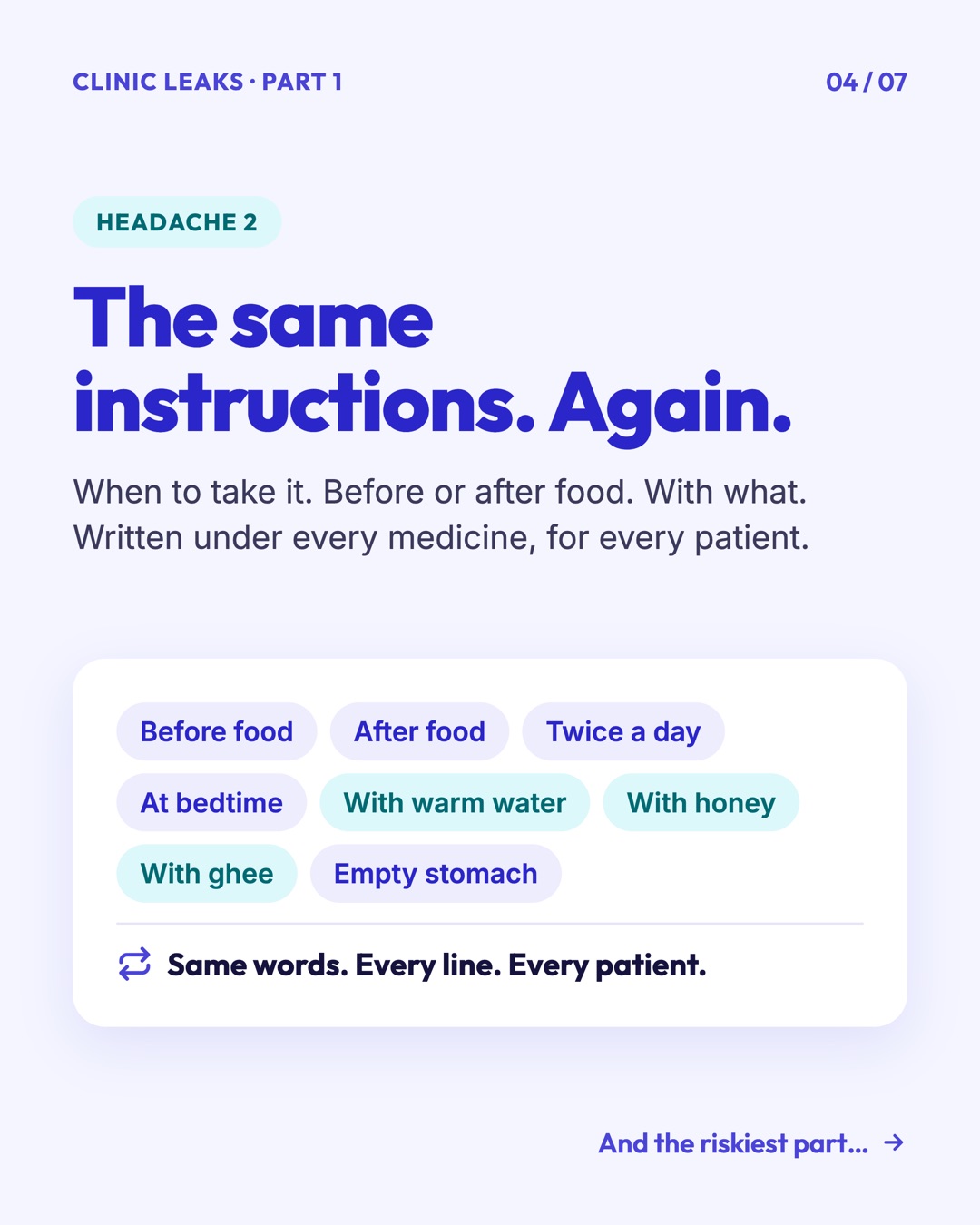
Under every medicine you write when to take it, before or after food, and with what. In Ayurveda these are not small print. The Kala (time of taking) and Anupana (what it is taken with) are part of the treatment. For how to write each clearly, see our guide on how to write an Ayurvedic prescription.
Because they matter, these instructions are the first thing to suffer when the OPD gets busy. By the twentieth patient, "with warm water" becomes "c̄ w/w", or disappears. The patient decides for themselves, often with tea or cold water.
Same words, every line, every patient. They are worth writing well once.
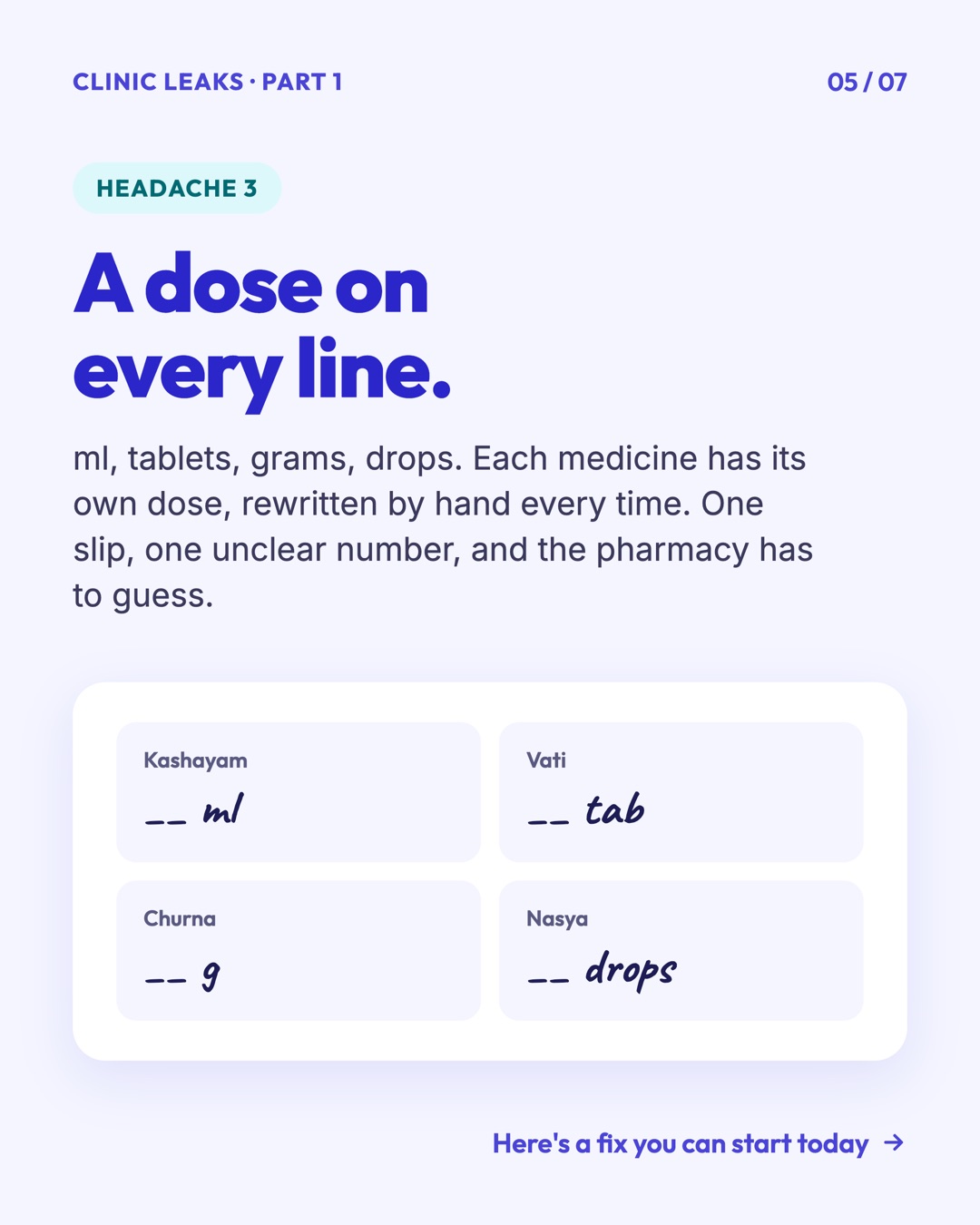
This is the riskiest of the three. Ayurvedic medicines come in different forms, and each form has its own unit:
Every one of these is rewritten by hand every time. One slip, one unclear number or one missing unit, and the pharmacy has to guess. Was that 15 ml or 5 ml? 2 tablets or 1/2? The person dispensing either stops and asks, which slows the queue, or guesses, which is worse.
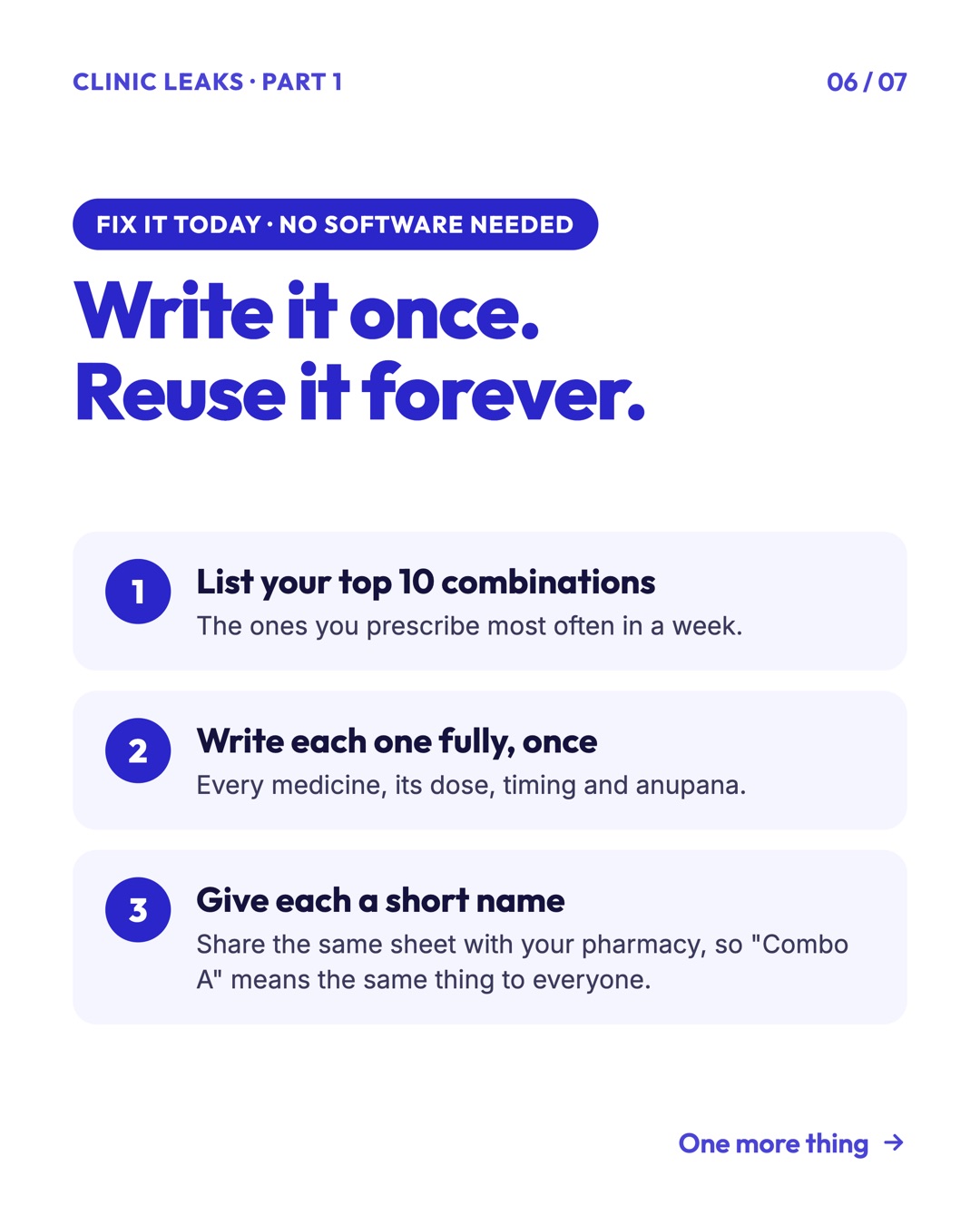
You do not need software for this. You need one sheet of paper, or one page in a notebook, and about an hour.
Look back over last week's prescriptions, or ask your pharmacy which sets of medicines go out together most often. Write down the 10 you prescribe most. For most clinics, these 10 cover a large share of the OPD.
For every combination, write each medicine with all of its parts:
Write slowly and clearly. This is the version every future prescription will be copied from, so take the care now that you cannot take in a busy OPD.
Name each combination something short: Combo A, Combo B, or a name that tells you what it is for. Then give an identical copy of the sheet to your pharmacy. Now "Combo A" means the same thing at your desk and at the dispensing counter.
A sheet might look like this:
| Short name | Medicine and form | Dose | Frequency | Kala | Anupana | Days |
|---|---|---|---|---|---|---|
| Combo A | Kashayam | __ ml | Twice a day | Before food | Warm water | __ |
| Vati | __ tab | Twice a day | After food | Water | __ | |
| Churna | __ g | Once a day | At bedtime | Lukewarm water | __ | |
| Taila | Local application | Once a day | Before bath | — | __ | |
| Combo B | … | |||||
On the patient's prescription you then write the short name, plus anything you changed for this patient: "Combo A. Vati 1 tab instead of 2. 15 days." Now the change stands out, because it is the only thing written by hand.
The free Ayurvedic Prescription Pad has a field for every part of the medicine line: dose, Kala, Anupana and duration, plus Pathya advice. Print it on your clinic letterhead or save it as a PDF.
A combination sheet removes most of the rewriting. But you still copy the combination onto every prescription by hand, the pharmacy still reads your handwriting, and the sheet cannot tell you what you prescribed this patient last time.
Ayumanager PRO does the same thing as the sheet, inside the prescription. You save each combination once as a formulation, with every medicine's dose, Kala and Anupana. On the next patient, you prescribe it in one click, change what this patient needs, and it is priced correctly on the bill. Every prescription is saved to the patient's case paper, so the last visit is there at the follow-up. Plans start at ₹599 per month; see the pricing page, or download the 2-page brochure (PDF).
Part 2: Tablets bought in kg, given out in units. So where does your stock really go? The pharmacy leaks most clinics never count. Follow Ayumanager PRO on Instagram so you don't miss it, see all parts of Clinic Leaks, and send this page to a colleague who writes the same combination twenty times a day.
What is a prescription combination in an Ayurvedic clinic?
A combination is a set of medicines a doctor often prescribes together for a condition, for example a Kashayam, a Vati, a Churna and a Taila, each with its own dose, timing and Anupana. Most Ayurvedic doctors have a small number of combinations they use many times a week.
How do I stop writing the same Ayurvedic prescription again and again?
List the 10 combinations you prescribe most often, write each one out in full once, with every medicine's dose, frequency, Kala and Anupana, and give each a short name. Keep the sheet at your desk and share the same sheet with your pharmacy, so the short name means the same thing to everyone.
Is it safe to use a fixed combination for every patient?
A combination is a starting point, not a rule. Check and adjust the dose, duration and Anupana for each patient's age, Prakriti, Agni and condition, and write any change on that patient's prescription.
Why do dosing mistakes happen with handwritten prescriptions?
Each medicine has its own unit: millilitres, tablets, grams or drops. When every dose is rewritten by hand in a busy OPD, a missed unit or an unclear number leaves the pharmacy to guess. Writing the full combination once and reusing it removes most of that rewriting.
Can clinic software save my Ayurvedic medicine combinations?
Yes. In Ayumanager PRO you save a combination once as a formulation, with each medicine's dose, timing and Anupana. You then prescribe it in one click, change anything for the individual patient, and it is priced correctly on the bill.
Should the pharmacy have a copy of my combination sheet?
Yes. If the pharmacy works from the same sheet, a short name like Combo A is dispensed the same way every time. Update both copies together whenever you change a medicine, a dose or a brand.
Book a demo and we'll show you how OPD, EMR, Panchakarma, and documentation actually work in the product.
Prefer to read first? Download the brochure (PDF)