
In short
Your supplier sends Vati in kg. Patients get them one by one. So how many tablets do you actually have on the shelf right now?
Most Ayurveda clinics cannot answer that without walking to the shelf and counting. The register says one thing, the shelf says another, and nobody is sure which one is right.
This is Part 2 of Clinic Leaks, our series on the small, daily losses in an Ayurveda clinic that nobody counts. Part 1 was about rewriting the same prescription for every patient. Part 2 moves to the pharmacy counter, where three separate leaks drain stock and money every day.
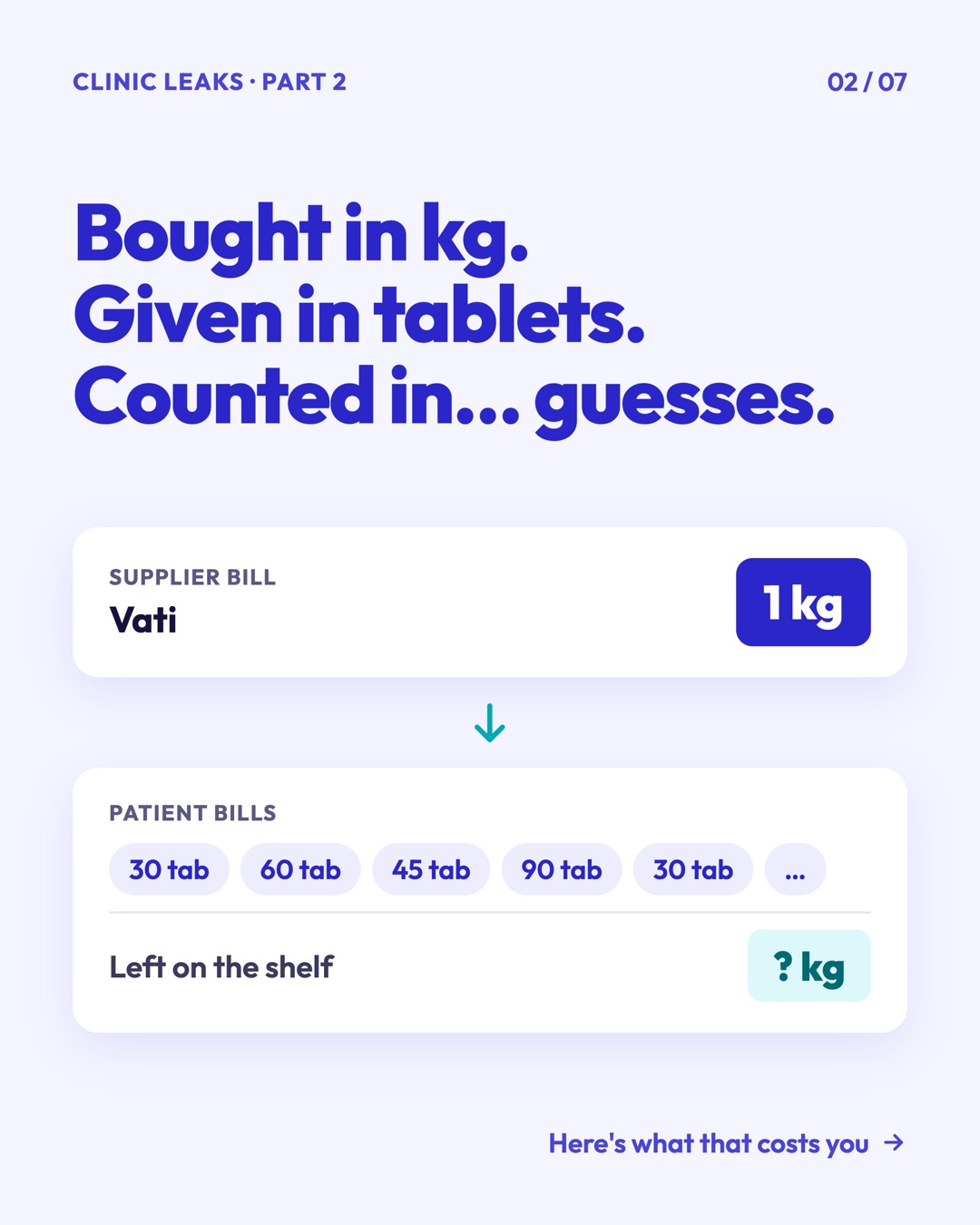
Follow one jar of Vati through the clinic:
Ayurvedic tablets are often bought loose, by weight, and dispensed by count. Churna is bought in kg and dispensed in grams or spoons. Taila and Kashayam come in litres and go out in bottles. Each of these unit changes is a point where the register and the shelf part ways.
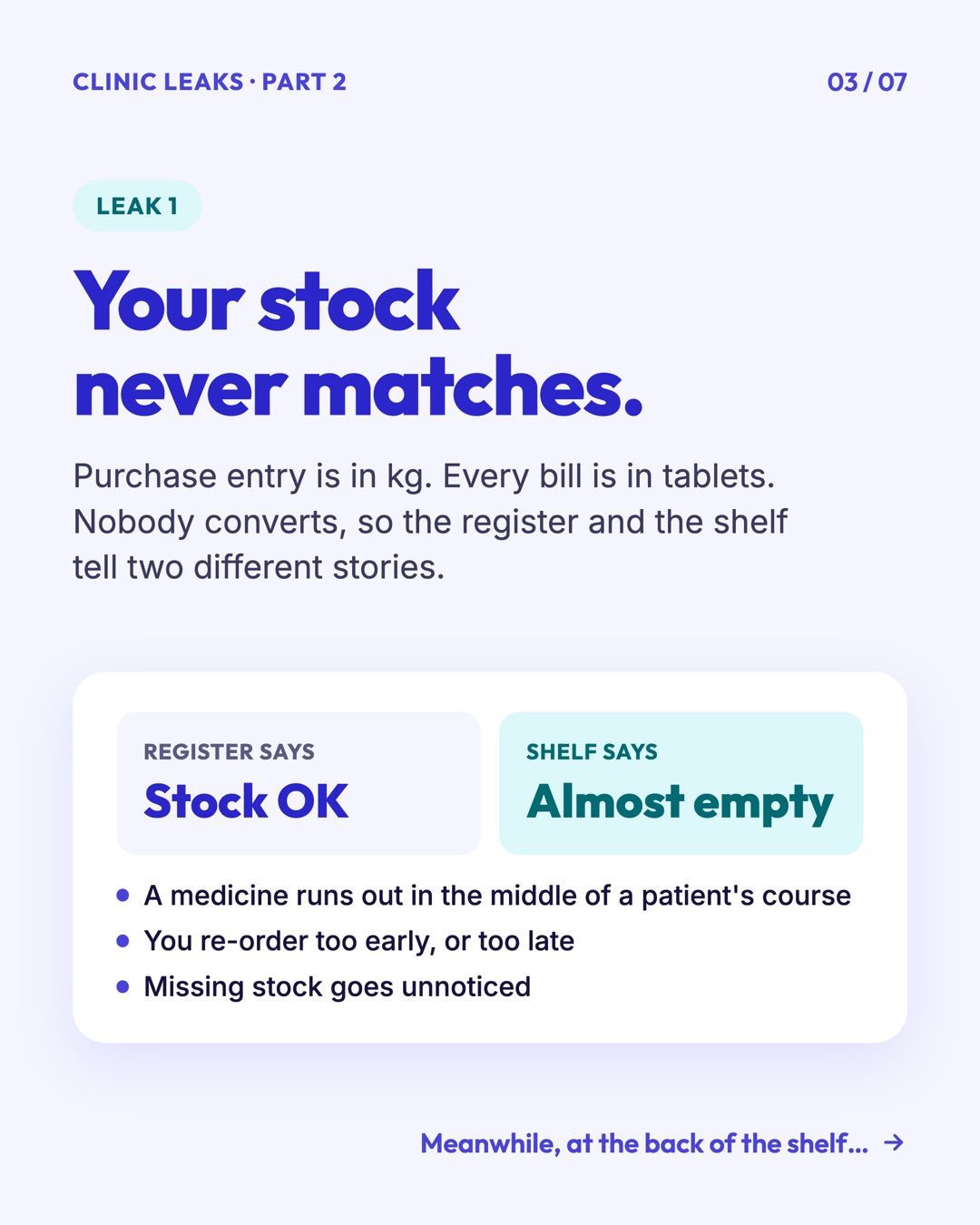
Purchase entry is in kg. Every bill is in tablets. Nobody converts, so the register and the shelf tell two different stories. The register says "stock OK". The shelf is almost empty.
What that costs you:
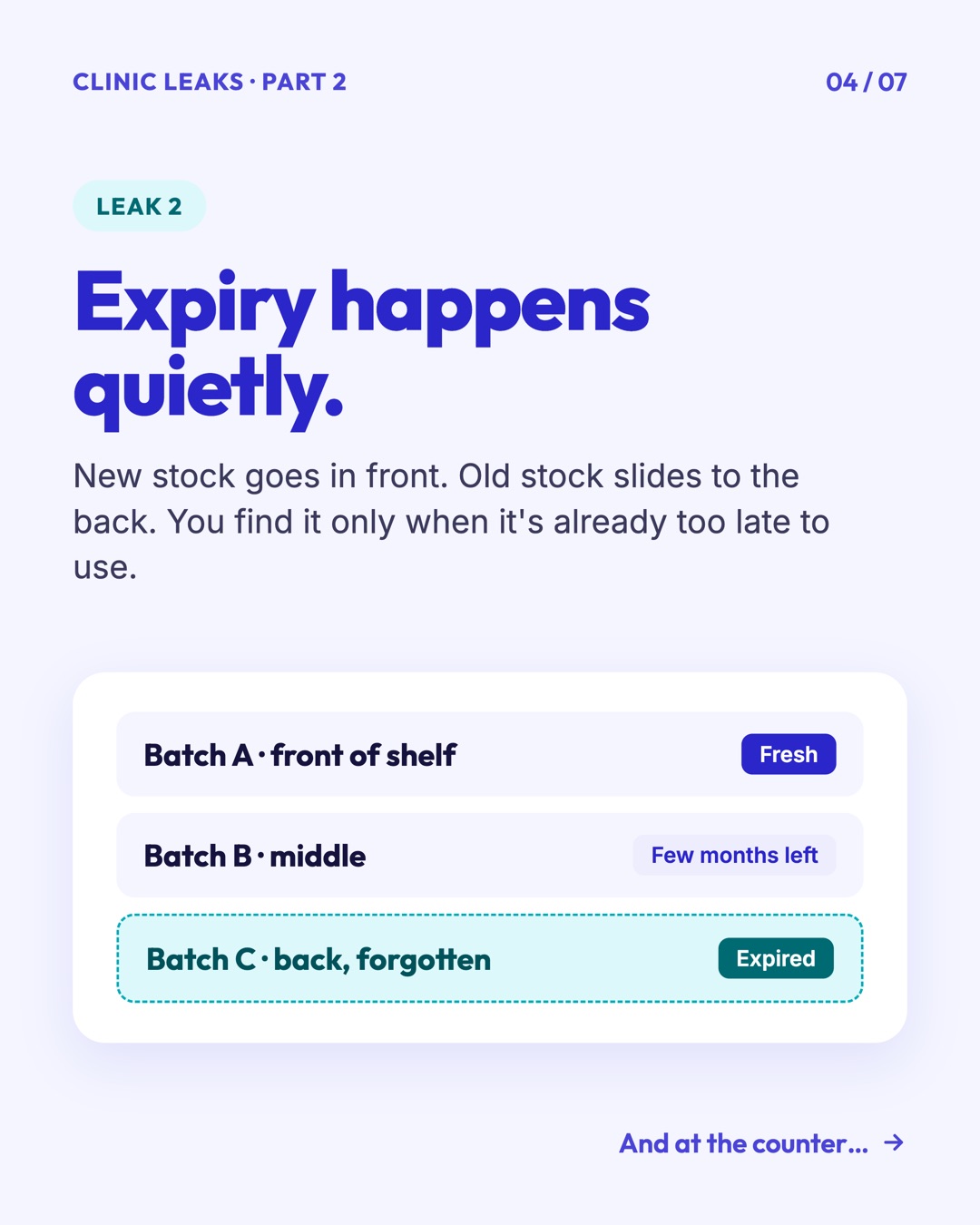
New stock goes in front, because that is where there is space. Old stock slides to the back. The staff member dispensing picks the nearest jar. You find the old batch only when it is already too late to use.
Expired stock is money spent twice: once to buy it, and again to replace it. It is also a risk: one expired jar dispensed by mistake is far more costly than the jar itself.
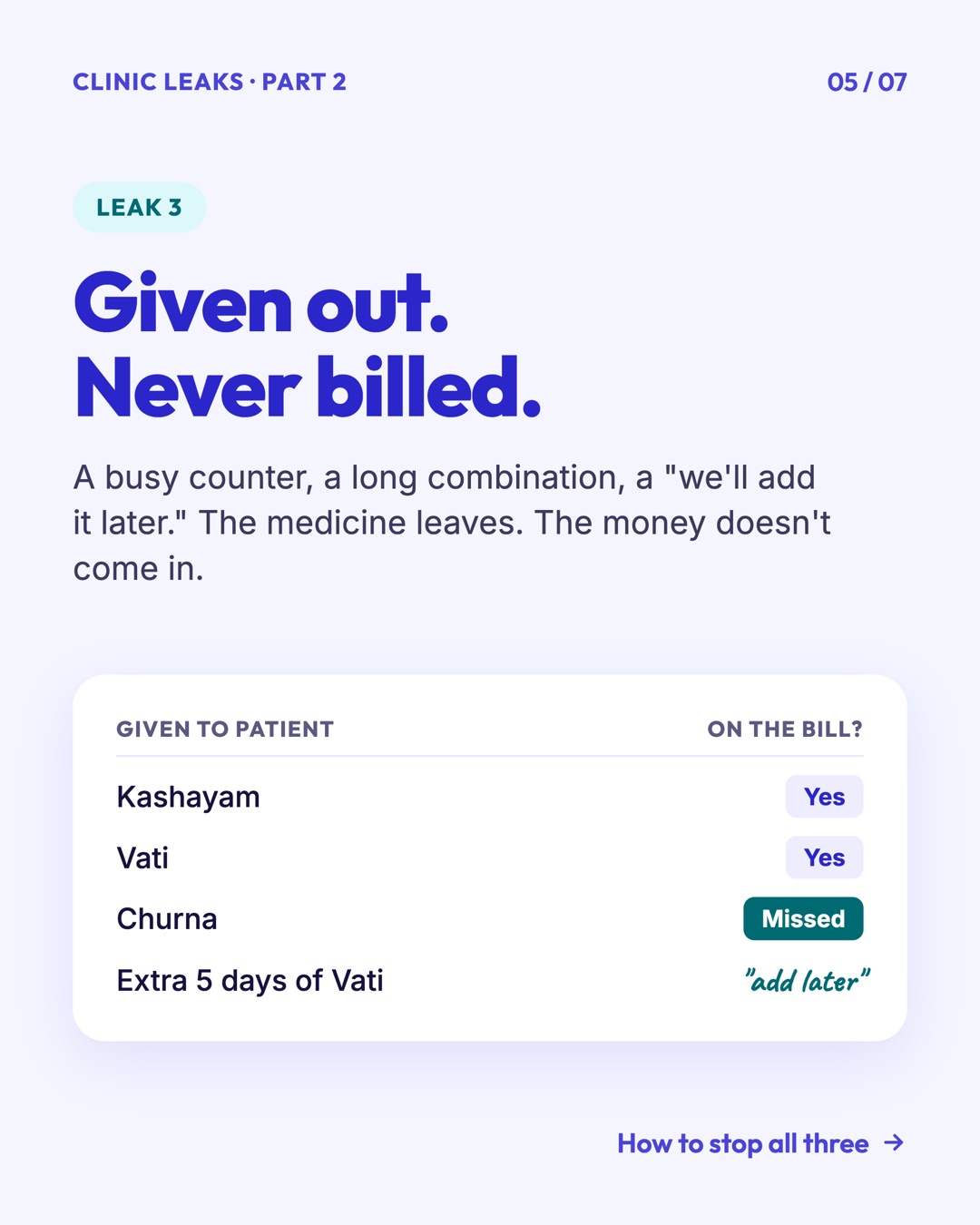
A busy counter, a long combination, a "we'll add it later". The medicine leaves. The money doesn't come in.
| Given to patient | On the bill? |
|---|---|
| Kashayam | Yes |
| Vati | Yes |
| Churna | Missed |
| Extra 5 days of Vati | "Add later" |
Nobody is being dishonest here. The counter is busy, the patient is in a hurry, and the third or fourth medicine in a combination is the one that slips. But every unbilled item is lost twice: the revenue never arrives, and the stock register now overstates what is on the shelf, which feeds straight back into Leak 1.
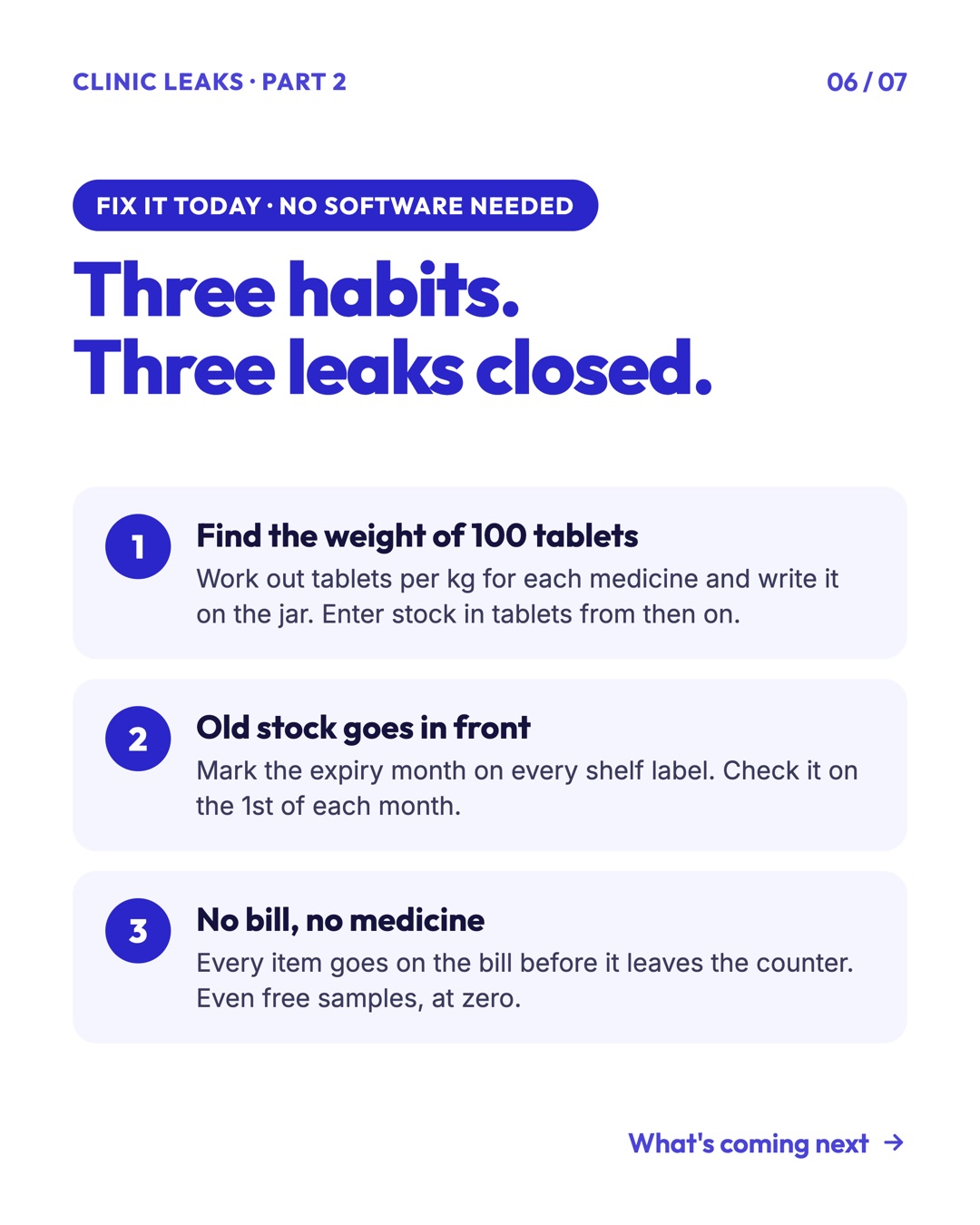
None of these needs software. Each takes a few minutes to set up and a few minutes a week to keep going.
For each tablet you buy by weight, count out 100 tablets and weigh them. Then work out how many tablets are in a kg, write it on the jar, and enter stock in tablets from then on.
Example: 100 tablets weigh 50 g.
1,000 g ÷ 50 g × 100 = 2,000 tablets per kg.
A 1 kg purchase now goes into the register as 2,000 tablets, the same unit as every patient bill. At any time:
Tablets bought − tablets billed = tablets that should be on the shelf.
| Purchased: 1 kg | 2,000 tablets |
| Billed this month | − 1,650 tablets |
| Should be on the shelf | 350 tablets |
| Actually counted | 260 tablets |
| Gap to look into | 90 tablets |
The figures are an example. The point is that once both records use the same unit, a gap becomes a number you can see and ask about, instead of a feeling that "stock is running out faster than usual".
A few tips for accurate counts:
Mark the expiry month on every shelf label, in large writing. When new stock arrives, put it behind the existing stock, not in front of it. Then check the labels on the 1st of every month.
Strictly, the rule is FEFO: First Expiry, First Out. Usually the oldest batch expires first, but not always, so go by the date on the label, not by when it arrived.
On the monthly check, look for anything expiring in the next two or three months. Dispense it first, or ask your supplier whether they will take it back. Some suppliers do, but only before the expiry date.
Every item goes on the bill before it leaves the counter. No "add it later", no exceptions.
That includes free samples and goodwill extras, billed at zero. A zero-value line costs the patient nothing, but it keeps the register honest and shows you how much you give away each month. That figure is often larger than clinics expect.
If billing at the counter is slowing the queue, the fix is to make billing faster, not to skip it. Keeping your most-used combinations written out, as in Part 1, helps here too: the pharmacy can bill "Combo A" as one known set of items.
These three habits only work if the person at the counter follows them. Share this page with your pharmacy staff, and set the 1st of next month as the first shelf check.
The three habits close the leaks, but they still depend on people doing the sums and checking labels by hand. As the OPD grows, that is where they start to slip.
The pharmacy module in Ayumanager PRO tracks stock and batches for both classical and proprietary medicines, with purchase tracking and low-stock alerts. Dispensing is tied to the doctor's prescription, and pharmacy sales go through the same GST-ready billing as the rest of the clinic, so what leaves the shelf and what appears on the bill come from the same record. Plans start at ₹599 per month; see the pricing page.
Part 3: Prakriti. Pariksha. Dinacharya. Your case paper is Ayurvedic. Is your record-keeping? Part 3 is on the case paper. Follow Ayumanager PRO on Instagram so you don't miss it, or see all parts of Clinic Leaks.
How do I convert Ayurvedic tablets from kg to number of tablets?
Count 100 tablets and weigh them on an accurate scale. Divide 1,000 grams by that weight and multiply by 100 to get tablets per kg. For example, if 100 tablets weigh 50 g, one kg holds about 2,000 tablets. Weigh a few sets of 100 and use the average, and repeat the check for each new batch or brand.
Why does my pharmacy stock register never match the shelf?
Usually because stock is entered in one unit and dispensed in another. Purchases are entered in kg from the supplier's bill, while patient bills are in tablets. If nobody converts between the two, the register cannot be checked against the shelf, so shortages and missing stock go unnoticed.
How do I stop Ayurvedic medicines expiring on the shelf?
Mark the expiry month on every shelf label, keep the batch that expires first at the front, and check the labels on the 1st of every month. Batches expiring in the next two or three months can then be dispensed first or returned to the supplier where the terms allow.
What is FEFO in a pharmacy?
FEFO means First Expiry, First Out: the batch with the nearest expiry date is dispensed first, whatever order it arrived in. It is safer than First In, First Out for medicines, because a later delivery can sometimes carry an earlier expiry date.
Should free medicine samples be billed?
Yes, at zero value. Putting every item on the bill, including free samples, keeps the stock register accurate and shows how much is being given away each month.
Book a demo and we'll show you how OPD, EMR, Panchakarma, and documentation actually work in the product.
Prefer to read first? Download the brochure (PDF)